Sushizock im Gockelwok

Sophie, Lisa, and I played a couple of games of Sushizock im Gockelwok tonight. This little game is fast becoming our “go to” game when we haven’t much time to spare or are not in the mood for something cerebral. This dirt simple, push your luck, dice game comes in a small box containing 12 blue “sushi” tiles (like thin dominos) numbered 1 thought 6 and 12 red “bones” tiles numbered -1 though -4, and 5 wooden dice each with two bone symbols, two sushi symbols, 1 red chopstick symbol, and 1 blue chopstick symbol.

The blue shushi tiles are randomized and placed in a row in the middle of the table, as well as the red bones tiles. The goal is to have the most points and players grab points by gathering blue (positive points) and red (negative points) tiles. The catch is that you can only count blue tiles for which you have a red tile but you must count all your red tiles. The order that you gather tiles is also important.

For example, if you gathered blue tiles in the order 5, 1, 2, 3 and gathered red tiles in the order -2, -1, then your score would be 3 (5 + 1 – 2 – 1). Remember, you can only count blue tiles for which you have a red. Since you only have two red tiles, only the first two blue tiles count. If you however, gathered another red -1, your score would grow to 4 (5 + 1 + 2 – 2 – 1 – 1). If you gathered yet another red -1, then your score would grow to 6 (5 + 1 + 2 + 3 – 2 – 1 – 1 – 1). If you gathered another red -2 then your score would drop to 4 since you must count all your red tiles regardless of how many blue tiles you’ve collected (5 + 1 + 2 + 3 – 2 – 1 – 1 – 1 – 2).

Tiles are collected in a Yahtzee-flavored mechanic where a player gets up to three rolls of the dice. All 5 dice are rolled the first time and the players must “lock in” at least one die each roll. When the player stops rolling (after 1, 2, or 3 rolls), the dice are evaluated and a tile taken. The player is free to choose whatever evaluation of the dice they choose but if in situations where the evaluation results in nothing valid, the player must take the worst tile left on the table.

So what do the dice mean? The sushi symbols represent the blue tiles and for each sushi symbol you roll, you take the corresponding sushi tile start at the left of the row. For example, if you rolled three sushi symbols, you’re free to take the third sushi tile from the left end of the row. The bone symbols work the same way but for the red tiles. Gathered tiles are stacked on top of one another (face up) in front of each player in two piles (red/blue). If three blue chopsticks are rolled, the player can steal the top tile from any other player’s stack of blue tiles. If more than three blue chopsticks are rolled, the player announces which tile in the stack he wishes to steal (without looking through the stack) and takes that tile and places it on top of his own blue stack. Red chopstick work the same but the player gets to steal red tiles from other players.

That’s the game. When all of the tiles are gone, players discard and extra blue tiles (if any) from their stack, sum the values and announce their final score. Sushizock im Gockelwok is a fun, light, family game that we’re getting a lot of mileage out of. We played two quick games in about 20 minutes. If you can find a copy, give it a shot. It’s a little bit addictive.

Funky Town & Board Game Evangelism

I’ve been struggling a bit with the direction of this blog. I started Marquand.net over 5 years ago (at times it feels like 20) and I had no idea what to write about. I’ve rarely had focus across the 1200+ postings. I’ve written about family, tech widgets, life pros & cons, board gaming, Mini Coopers, and the odd curves life throws at you. I’ve dabbled in photography, tie-dyed shirts (still doing that btw), pictures of other people’s game shipments, woodworking, and online game implementations. But, I’m finding I’m a bit lost on how to proceed. I am a bit blocked. I’m in funky town.

It’s not like I have less to write about. In fact, it’s quite the opposite. I’ve got lots of things I could write about but I’m feeling lazy. Pictures and comments I would normally upload to the blog, I’ve just been posting with little context in an album on Facebook where I get more feedback. Do people even read “macro” blogs any more? Do tweets, Facebooks, MySpaces, and other “micro” blogs satisfy the A.D.D. crowd these days. Is my blog a dinosaur that missed the news about the life-killing meteor?

So, to get myself up and out of this blogging funk, I thought I’d talk up some game evangelism. Maybe somebody will find it through a Google search and find some good in it…or maybe not.

As I’ve mentioned numerous times before, I didn’t grow up playing board games. In fact, I didn’t like them. I actively avoided playing games. I didn’t see the fun in them. Playing a game was very stressful. I’m convinced that I subconsciously felt that the cerebral battle of the game was roughly equivalent to a medieval joust…a test of manliness…something where the amount of chest hair mattered. If you lost you were a failure…a wuss. I’d always done well academically. In fact, I found most cerebral activity relatively easy to comprehend. I have a knack (I think I do anyway) for being able to visualize intangible and abstract concepts and hold them steady in my mind’s eye. I’m convinced that’s what drove me towards computer science. I “see” the data structures and how abstracts concepts interact with one another within running software. Design is just documenting what you “see”. However, even with this “ability” I usually found myself on the losing end of games. And that got under my skin.

It wasn’t until long after college and long after being exposed to people from all walks of life, that I realized that people are wired in all kinds of ways that may or may not make them a winning gamer. Being “smart” helps, but how much effort you’re willing to put into a game and how you naturally come by your “smartness”, your wiring so to speak, has more to do with winning than your IQ. And that got me thinking…what’s up with this winning thing anyway. Sure I want to win, but more importantly, I just want to play moderately well in the company of friends. And when you get right down to it, I’d take playing poorly with a good company of friends over playing well in the company of jerks…even “smart” jerks.

Playing games has made me a better gamer. If I had to estimate, I’ve played upwards of 250 different card and board games. After a while, the rules of a new game become relatively easy to absorb. However, rarely am I the “lucky guy” that wins a new game on his first play. I’m not usually one to quickly grok a viable strategy and stick to it. I usually fumble around a bit, play by my gut, change tactics, notice that I’ve been painted into a corner (many times due to my own ineptness), etc. but I always have fun bringing up the rear. I have my moments and sometimes win but usually I’m somewhere in the middle or bringing up the rear…and I’m okay with that.

In contemplating my attitude towards gaming I’ve come to the realization that I enjoy teaching a game as much as playing it. More specifically, I enjoy teaching a new game to new gamers…gamers that are hungry to learn more games. Now, don’t get me wrong, I have a fantastic time with my more “hard core” gaming group. We’re all relatively seasoned gamers and will play most anything (well…a play time of more than, say, 90 minutes is probably pushing the limits of tolerance). We have a healthy and fun degree of competition and enjoy each other’s company. It feels more like a “guy’s night” of poker and not a cerebral jousting match.

But I am, in some ways, more excited about another group I’m trying to keep afloat: my “gathering of friends” group. The group, although “seeded” from some of my regular group, includes spouses and friends that are not gamers but are willing to give it a shot. I’ve made several specific game purchases for this group in hopes of rounding out my collection to suit the entire spectrum of games from the heady, brain-burning strategic games to the more light-weight, more luck-driven, table games. My motivation for the group is selfish in that I really just like to spend time teaching games to a group of friends that don’t necessarily have something in common and I like that games can provide a backdrop, a structure for some lasting relationships.

Okay…after writing all of this I realize I strayed from evangelism and mostly into blathering but I don’t feel as funky as I did at the start so bear with me. I’ll leave you with, what I hope, is a feel good story. During one session of my “gathering of friends” group, the spouse of one of my “serious” gamer friends approached me, pulled me aside, and quietly yet profusely thanked me for getting her husband into gaming. Her husband, mind you, since becoming involved with me has purchased some 40 or 50 board games and quite frankly may have shopping issues 🙂 so I was actually taken aback by her comment. She continued that since he’s been gaming, they’ve spent more time in the evenings playing games as a couple and they’ve spent more time with their extended family having them over for “game nights” and for that they’ve grown closer as a couple and they’ve become stronger as a family.

Well, you’re more than welcome and I hope it continues.

Some Press Coverage

I received a BGG email informing me that Marquand.net got some press coverage in the July 13th edition of Phoenix’s daily newspaper, the Arizona Republic News. The short article, concerns the rise in popularity of playing board games and the benefits of the social aspects. A link to Marquand.net is referenced in a sidebar of places where you can “try before you buy” listing my implementations of Clans, Coloretto, Ingenious, and Lexio.

The games are coming, the games are coming…

One is by land…a whole bunch by air…

Way back in early April, I gathered a few game orders from a couple of people in my gaming group and placed an order that included Dominion Intrigue from coolstuffinc.com. Intrigue was a preorder which would hold up shipment but given the expected release date, we’d only have to wait about a month.

May came and went…and then June came and went. But today I checked and the order had shipped! So on Monday, I’ll be getting my copy of Intrigue, Caylus Magna Carta, Catagena (I), and Medici.

As if that wasn’t enough already, a recent trade I made with a gamer in Pennsylvania (giving up Galaxy Trucker for an out of print, Pro Ludo, in-shrink copy of Keythedral) should also arrive on Monday. It’ll be like Christmas.

I guess I should also mention that with Keythedral, my collection reaches 125 games. Small by comparison to the real go-getters on BGG but, relatively speaking, firmly planted in the land of the sick for the general population. Welcome to my reality.

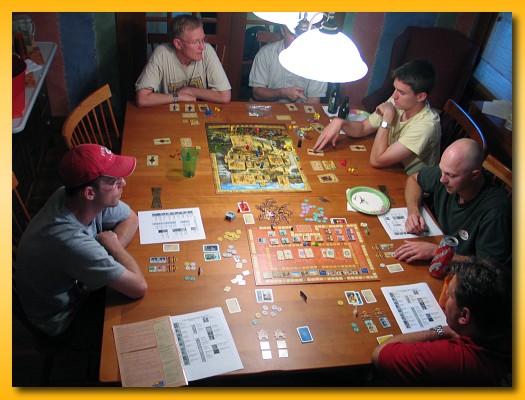
Analog Game Night – July 2009

We met at my house for the July 2009 installment of Analog Game Night. I thought it was going to be a light turnout since three relatively regular members couldn’t make it but we ended up with 8 including a new person I’d invited from work, welcome Chris! Chris is an annual GenCon attendee but hadn’t found a group to play with here in Columbus and had fallen out of the habit of playing on a regular basis so hopefully we can change that.

As usual, we opened up the table and split into two groups of four. The far end of the table started with Bob’s copy of A Castle For All Seasons. Unfortunately, I didn’t get to play the game since I ran the near end of the table setting up In the Year of the Dragon.

Since I didn’t get a chance to play “Castle” I can’t really comment on the game but it did look interesting. Man those building are some pretty healthy sized chunks of cardboard! “Dragon” can be a ruthless game and our random event setup was brutal. Most events were coming up in pairs and since that’s not allowed they were only separated by one tile with a layout like Contagion, Drought, Contagion, Drought, … Unfortunately, I’d been rushed into boning up on the rules the night before and missed a couple highly significant rules: 1) if you pass taking and action you can replenish your money up to 3 yuan (holy cow that hurt several of us) and 2) you must return half of your fireworks to the general supply after the festival event.

I like “Dragon” a lot but I play it poorly. It seems I’ve been saying that a lot recently and I’m starting to wonder if my aged brain is starting to lose its edge. Even though I seem to be running in a major slump I’m still having a lot of fun with the hobby and can’t wait for my next game.

After Castle, the far end played Hibernia a game I received as a review copy. I was very grateful for their efforts and it provided a unique opportunity to get lots of feedback on what it’s like to play the game cold given that none of them had any idea what the game was about. I’m still gathering feedback and would like to get some more plays in myself and hope to post a full review soon.

My end of the table was still dragging through Dragon but after Hibernia finished we lost two players and the six of us played For Sale. A light but fun filler/closer. After For Sale, we lost two more players so I cracked open my new copy of Sushizock im Gockelwok and the remaining 4 of us played that.

I’d jumped on Bob’s order from Game Surplus and, lucky for me, it had arrive just in time for game night. So Bob brought over my new copy of Sushizock im Gockelwok and a copy of Antike…gotta love that rondel!

Thanks guys for coming; great turnout!

Analog Game Night – June 2009

The last few weeks have been extremely hectic with birthdays, end of school, parties, baseball, softball (Sophie is playing in two leagues this summer), etc. but I did manage to squeeze in some time for the June installment of Analog Game Night.

Unfortunately, I don’t have any pictures because I somehow managed to forget my camera. We met at Bob’s house (a first time hoster…thanks Bob!) with a small group of only four this month. Three/Four is, in my opinion, the sweet spot for most games so for me anyway, it worked out quite well. Bob had recently picked up a copy of The Princes of Florence and although it took quite awhile to get up to speed on the rules, I had a great time. I’d never played PoF (I know, I know…) and I was impressed. If I had one excuse as to why I stayed away from it, it was because of the auction. For years I’ve been an auction bigot and if the game had an auction…it wasn’t for me. Although it’s taken a long time, the auction mechanism is growing on me as long as it isn’t a major aspect of the game. The auction, although very important, didn’t seem to dominate the play. I can see how more plays will help me determine the value of items and therefore trigger some more intense auction combat, but I still think there are many other aspects of the game worth exploring. I’m looking to pick up a copy for myself.

Tim had to take off after PoF and I’d brought my copy of Amazonas (Bob had requested it). It’s been a long time since I’d played but we seemed to get up and running pretty quickly and were burning through the event cards as fast as we could. With three, the competition for village building plots was relatively mild. It may have been due to the hidden “goal” cards that we’d been given but for whatever reason, we only had a few times when you could hear a groan when a village was built. I’m not sure I’d purchase Amazonas were I faced with the option again but I have had a lot of fun playing it over the years. It only supports 3-4 players which is too narrow for my tastes these days. I have to really like a game to consider buying it if it only goes up to 4. 3-5 is preferred with 2-5 comfortably clearing the bar and onto other selection criteria.

As a closer we played Sushizock im Gockelwock; a fun little tile/domino collection game. Surprisingly simple to learn and quick to play, it makes a great filler for opening or closing a game night with gamers or some light play with your family. There’s a lot of luck involved with the rolling of the dice but you can work the odds and push your luck. I’m looking to pick up a copy. I had a great time playing.

Well, thanks for a fun time at AGN June 2009 and I look forward to next month.

Rails of Europe

I received my copy of Rails of Europe about 5 months ago and I have yet to play it. So I cracked the box last night and reread the Railroad Tycoon rules (the base game that Rails expands) and set up for a solitaire game. It didn’t take long before I realized that there’s just too much going on to keep track of independent players to make it really a game. However, I did enjoy being able to work through the rules and, embarrassingly enough, fondle the bits. I’ll not go through the rules but in short, Rails is a good delivery game. Your job is to connect cities by building railroads between them. Once connected you can ship cubes between cities using the rail lines. Different terrain types affect the cost of the track and colored cubes must be shipped from their original location established at the beginning of the game to a city of corresponding color. You move up the victory point track when you ship cubes which earns you more money each turn. You’ll most likely need to sell shares in your company to raise cash to build rail lines but doing so forces you to pay dividends each turn reducing the cash you have available on your turn. If you’ve played Ticket to Ride or Union Pacific, you might think this games are similar because there are plastic trains and you “build track” but the similarity is only superficial. Rails is much more of a “gamer’s game” and there are many more goals to think about, money to manage, and decisions to make about where to build. The smaller board brings players into contact much sooner than RT setting the stage for a potentially more challenging and confrontation game.

The board is 2/3 the size of Railroad Tycoon and I thought I’d be fine playing without my dining room table opened up but, unfortunately, it’s very tight even with the smaller size. I beginning to think the only way I’m going to get a set of very specific games to the table will be to organize a special game night with the games already chosen.

And…..They’re Off!

It was getting a bit late last night and there were only three of us but we decided to kick ourselves off the computers and play a game. Since it was late I scanned the titles in my collection and decided on something that wasn’t heady and if push came to shove, we could cut short. Winner’s Circle was the winner.

Neither Noah nor Lisa had played before and it had been since October since I’d played but WC is extremely easy to teach and with only a couple pages of rules it doesn’t take much to get back up to speed.

The game comes packed with a board representing a track, fat plastic horses in varying colors, thick cardboard placards depicting a horse’s abilities in 4 areas (horse head, saddle, helmet, horseshoe), some money chips, 4 betting chips per player, and a 6-sided die with 3 sides depicting a horse head, and the other three sides depicting saddle, helmet, and horseshoe.

The game comprises three individual races. The horses are lined up and the placards are turned up and assigned to specific horses. In round robin fashion, players place bets on horses (a betting chip depicting 0, 1, or 2) until all 4 betting chips have been placed (you can’t bet on the same horse twice). Once all betting chips are down, the race begins and the starting player rolls the die. The player then chooses any horse and moves that horse forward on the track according to the number on the placard that matches the symbol rolled on the die. After moving the horse, the placard is turned over and the horse is not allowed to move again until all other horses have moved.

The game does have some pretty significant back stabbing aspects to it since you can, for example, on a bad roll choose a horse you didn’t bet on and move them a small amount. Making situations worse is that it’s not allowed for horses to occupy the same spot on the track. If, when moving forward, your horse lands on an occupied spot, you must back up until the first free spot opens up (maybe all the way back to your original position). Congestion on the track can really devastate some moves restricting some horses from breaking out of the pack.

The first horse that passes the finish line is moved to the center of the track followed by the 2nd and 3rd horse. When the 3rd horse crosses the line, the race is over and the horse in last place is moved to the center as the “last” horse. At this point, a payout occurs and using a chart on the board, players determine the value of a bet based on the finishing position of a horse and receive money based on the value of their betting chip. The 0 betting chip pays nothing but is used as a bluff bet since it looks as if you intend to split a reduced pot for the horse and may make others choose another horse. Players that have bet on the “last” horse owe money to the bank.

That’s basically it, you set up for the next race and go again. The game is relatively random but fun. We played with the Royal Turf variant where you use the 0 betting chip and bets are secret (placed face down). In addition the “horse head” value of the placard (the most common dice roll since it’s on 3 sides of the die) must be different for every horse in the race. It bothers me somewhat that the horses are always lined up in the same order behind the starting line and they don’t start from a flat start as in a real race. A variant I might like to try would be to turn up placards and place bets but then randomly assign the start order to represent the random nature of a good/bad start as the come out of the gates.

Winner’s Circle is a chaotic bit of fun that is pretty much a crap shoot strategy-wise but I’m glad to have something like it in my collection. If you can find a copy just about anybody can play (gamers and non-gamers) and the theme ties in relatively well to real life so players shouldn’t have much of an issue at quickly picking it up.