Alhambra – Review

Alhambra is a 2003 title designed by Dirk Henn. I’ve owned it for years and felt it was a so-so game but after realizing I’d played it wrong, I wanted to get it back to the table. Unfortunately, the box kept getting pushed to the back of the game shelf to gather dust on its plodding journey to the trade list.

However, at a recent Great Lakes Games gathering, I had the opportunity to play it near the end of the convention and (of course playing it correctly this time) I had a great time. The game moved along faster than I remember and although there aren’t major decisions to be made, there are enough to keep it interesting. There is a place and time for real brain burners where most of the time is spent in silence analyzing the ebb and flow of strategic and tactical moves of sparring opponents but there is also a place and time for games that, rather than burn, apply a salve to the tired brain, possibly teasing out a bit more fun than work.

The game is simple, featuring a four-stalled market placed in the center of the table with each stall containing one tile (pulled randomly from a bag) and four face up cards (money). The cards come from a deck of 4 suits (matching the 4 stalls in the market). On your turn you either take cards from your hand, all matching the suit of the market stall to buy the tile in the stall, or you take one of the face up money cards. Every time you pay exactly what the tile costs (putting the cards in the discard pile) you get an extra turn. The first time you take a money card or overpay for a tile (there is no change) your turn is complete. You are allowed to take two face up money cards if both have a value less than 5.

After buying tile(s) you place them in your personal Alhambra in front of you adhering to some relatively simple rules. Turn order is strictly clockwise so with less people you can plan for gathering money to grab that juicy market tile. With more players the less you are able to plan for the state of the market by the time your turn arrives.

At the beginning of the game the money deck is split into roughly 5 equal piles and a scoring card is shuffled into the 2nd and 4th piles and then the piles stack on top of one another. When a scoring card is pulled up to replace a card in the market, the game pauses and everyone scores their Alhambra. The tiles depict different colors and you determine majority in colors, look up values on a chart and assign points. In the 1st round only 1st place scores. In the 2nd round points are awarded for 1st & 2nd place. The 3rd scoring round occurs when the last tile is pulled from the bag and points are awarded for 1st, 2nd, & 3rd. In addition, each round affords each player points according to the length of the longest contiguous “wall” (dark border on the tile) that follows the outside of the Alhambra. In last night’s game, I managed to complete a perfect wall around my Alhambra with no gaps (see above). Very lucky.

I’m glad I got the opportunity to play Alhambra at GLG because it saved it from the trade pile. I’ll be looking to play it more often in casual settings.

Great Lakes Games – Sunday – 2011

Great Lakes Games 2011 has come to a close and I’m back home with the post-board game convention blues. I played 22 games over the 3 day period, 15 of them were new to me. My brain is fried but I’m already looking forward to next year.

I felt like I played relatively competitively getting second many times and first a few times but as the hours of each day waned my brain became more and more mushy. Even simple games that I would usually play respectably were tough. However, I was still happy to play them with great people.

Here’s the list of games I got to play, in the order I played them:

  1. Die Burgen von Burgund (new to me)
  2. Poseidon’s Kingdom (new to me)
  3. Kingdom Builder (new to me)
  4. Nefarious (new to me)
  5. San Marco (new to me)
  6. Vanuatu (new to me)
  7. Automobile (new to me)
  8. Confusion: Espionage and Deception in the Cold War (new to me)
  9. Aton (new to me)
  10. Hawaii (new to me)
  11. London (new to me)
  12. Kingdom Builder (new to me)
  13. Moongha Invaders: Mad Scientists and Atomic Monsters Attack the Earth! (new to me)
  14. Québec (new to me)
  15. Fortuna (new to me)
  16. Kingdom Builder (new to me)
  17. The Bottle Imp
  18. Maus au Chocolat
  19. Dice Town
  20. Keltis: Das Kartenspiel (new to me)
  21. Alhambra
  22. Turn the Tide

Of the games I don’t already own, the definite buys for me were Die Burgen von Burgund, Vanuatu, and Hawaii. The potential buys were Kingdom Builder, London, Quebec, and San Marco. The games I won’t be buying were Fortuna, Poseidon’s Kingdom, Nefarious, Moongha Invaders, Keltis, and Aton.

If you’d like to hear additional thoughts on a specific game, feel free to contact me or leave a comment. Well, it’s only 365 days left and counting until GLG 2012 begins.

Great Lakes Games – Saturday – 2011

Getting out of bed on Saturday morning was rough. I got up late and after grabbing some breakfast I sat down to a game of Moongha Invaders, an odd Martin Wallace game of monsters invading cities around the world. It’s a pretty light-hearted battle game with some recognizably eurogame mechanics. From what I understand there were only 600 copies of the game made so they go for crazy amounts of money. I’m glad I got to play it and the collector in me would like a copy but I suspect it wouldn’t see a lot of play time.

Quebec was another game on my must-play list and although I liked playing it, I’m wondering if I should buy it or not. The game lasts four rounds and players try to build buildings by contributing cubes (workers) to the construction process. Once a player leaves one building and starts building another building, the contributed cubes move to regions of the board where a round ending majority scoring process takes place. There are lots of other things going on but it’s basically an area majority, cube pushing game.

Next up was Fortuna. I wasn’t fond of the game but it’s rated relatively high on BGG. It’s not that it’s bad per se but there’s just not much to hang your hat on. Players attempt to take the actions on a limited set of cards in order to move a pawn up a track. Move far enough and you trigger the end game. There are cubes, cards, buildings that afford players special actions, dice, and various other things but it all seemed a rather bland game. The artwork is awesome but the game…meh, not so much.

I participated in the annual GLG prize table and managed to walk away with a copy of Ninjato. We’ll see how it goes.

I was involved with several lighter games as the night went on including Bottle Imp, Kingdom Builder, Maus au Chocolate, Dicetown, and closed the night with the card-game form of Keltis (a semi-reswizzled form of Lost Cities).

Thanks to the time change, it’s now only 2:30am so hopefully I’ll be able to get up in time to still get breakfast in the lobby. I’m looking to grab a least one more short game tomorrow morning (so that I can claim to have played more games this year than last) and then hopefully stay awake for the three hour drive home.

Great Lakes Games – Friday- 2011

We started off with Vanuatu. This game features a really neat mechanism where players use worker placement to take actions to move your boat around between islands and ocean that come out as the game progresses. You build huts, fish, dive for treasure, sell fish, creating art for the tourists, fly tourists to the islands, fight for start player, etc. The order that you take these turns is relatively ingenious, having players vie for a plurality in the action “boxes”. You might try to program the order of moves you want but other players can thwart your plans and not allow you to take your actions in the order you expected. This game is a must buy for me. It’s on the thinky and last a couple of hours but I really enjoyed it.

Next up was Automobile. It’s a standard Wallace game so there are penalty cubes, loans, and variable turn order as players vie for building car factories, producing cars, and selling them. However, it’s not that easy to be efficient and build the right models of cars in the desired numbers to meet a fluctuating demand. Not my favorite game so I’m thinking about putting my copy up for trade.

While others jumped out for some lunch we played a two-player game of Confusion: Espionage and Deception in the Cold War. It’s the goofiest title ever for such an abstract game. Players face off with chunky tiles on a chess board and your goal is the move your pieces to the middle of the board, pick up a little “briefcase” tile, and transport it to the other end of the board. However, at the start of the game you don’t know how your pieces can move and you must deduce their allowed movements by trial and error. Your opponent can see how your tiles can move and must validation or invalidate your attempts to move the piece. At one point I thought I wanted to pick up a copy but I’m glad I waited to give it a test run.

Aton is a quick little, older, two player game that we knocked off before heading into the next Essen title.

Hawaii is a fun game that’s got a lot of familiar mechanics wrapped up in some nice variability from one game to the next. Players gather “feet”, shells, and fruit and use them to travel around a variably set up board buying buildings and other items that are placed on a “Vikings-like” tableau. You must build enough in each row to extend past a scoring limiter. The game is a bit fiddly to set up but it’s manageable. I had a lot of fun playing and it’s pretty high on my want list now.

We next sat down to a copy of London, a St. Petersburg-ish feeling game of collecting cards and playing them onto your tableau and activating them to score points. Quintessential Wallace, the game includes “poverty” cubes and loans (although no variable turn order). I found it interesting but potentially a bit too much like (in feel) to St. Petersburg.

Everybody headed to bed, and I should have too, but we stayed up and played Kingdom Builder one more time. It’s almost 4am and I really need to get to bed. My brain already feels like mush.

Great Lakes Games – Thursday – 2011

Whew! It’s finally here. It’s almost 2am and I’ll need to keep this short so that I’m not too burned out tomorrow. We arrived at about 1:15pm, checked into our room and grabbed a quick lunch at Bob Evans just down the street. We rushed back to the conference room and quickly got into a game of Die Burgen von Burgund.

Sorry for the very blurry picture but that’s all I’ve got to show for it. I was looking forward to playing this game and really liked it. There’s a lot going on but luckily Josh Miller sat with us and taught it. The game is basically a set collection game with tiles that you gather from a central board and eventually place them into your kingdom. You use dice to determine the two actions on your turn and you’re looking to gather tiles that when played allowed you to chain actions together giving you the most points from your action buck. Like I said, lots going on but a very neat system. Lots of different boards keep things variable and interesting from one game to the next. Definitely on the buy list.

Next up was Poseidon’s Kingdom. The cute bits deceive you into thinking it’s a child’s game but wow, are the rules a challenge. In the end it’s relatively simple but still overly difficult for what’s really going on. You basically collecting dice that fall onto the board when the circular wave tips onto the board while you avoid the roaming shark. You use collected dice to “buy” points and “free your friends” from the Kraken. The Kraken Track is a bizzarre feature that speeds up the game (thankfully). At $100+ dollars…yeah….ain’t happening.

Next up Kingdom Builder. Some say it’s like Through the Dessert but I think they must be smoking crack. True, you place a number of huts on the board and you’re trying to score points by doing it, but limitations on where you can place your huts and the goals you shoot for while placing them is phenomenal for such a simple concept. The variable boards you use plus the goal cards dealt at the beginning of the game will keep this game fresh for a very long time. A definitely buy.

Next up was a filler called Nefarious. You’re trying to score points by “building/buying” inventions; a couple of cards dealt try to keep the game fresh from one play to the next. Mix in some 7-Wonders style adjacent player rules related to earning money on how accurate you are at guessing what they’ll play and you’ve got a game that moves very fast and can be over before you feel like you’re even out of the box.

To close we played and oldie San Marco. I was not kind to San Marco in the past due to the down time on the card distribution phase but it wasn’t bad at all in our game. We played with three so the splits felt very painful. The game features an I split, you choose mechanism where cards are dealt and one player splits them into “offerings” and the other players pick them leaving one last offering to the person that performed the split. The cards allow you to perform actions on a board that play out much like a simplified El Grande board scoring points for the player with the most in an area and to the player who has the second most. I enjoyed it this time and would play ago.

That’s all I’ve got time for. It’s getting very early. Looking forward to a lot of games after a few hours of shut-eye.

Impromptu Game Day – October 22, 2011

A friend of mine organized a small gathering yesterday and we all took a vacation day to play games at his house. We all struggle with getting some of those unplayed, older, and rarely played titles to the table and these gatherings provide a great opportunity for us. I’ve said it many times before, but I’m always amazed at how few games we can play in a day. I always have unrealistic expectations of burning through stacks and stacks of games by the end of the day but, reality bites.

We started the day with an unplayed title, Metropolys. The steam-punk reminiscent box art has always kept me wanting to give it a try. The game is really an abstract with some theme thrown in. The board depicts a map of a city with regions separated by canals. Each region is divided into smaller colored regions divided by streets. Tokens of various types are placed on some of the regions and your job is to take control of the small regions, vie for the good tokens (shunning the bad), as well as grabbing control of the larger canal-separated regions. Every player starts with the same set of 13 buildings (think Mexica) numbered 1 through 13. The start player places a numbered building in one of the small colored regions and subsequent players must pass or place a larger numbered building on a different colored regions that is adjacent to the last building bid. The winning bid grants the colored region to the player and the building is turned over and becomes permanent fixture of the board. Play continues until somebody runs out of building. Cards dealt randomly to players at the beginning of the game give players hidden goals that grant points if achieved (e.g. 4 points for each group of 3 connected buildings). It’s a very simple game that has it’s place as a opener or filler game. It’s relatively light but fun. The artwork is really great.

Next up was a really old title, El Grande. I’ve played it twice in the last 8 years (about 2-3 years apart) so, to stay on track, it was due. My fellow players were new to the game but I think they liked it. The game is very chaotic with the max number of played but was relatively controlled with the number we had. I was glad to get this area majority game back to the table after a long hiatus. I usually find myself fighting too many losing battles with too many different players but I stuck to my plan this time and it seemed to work. The power of grabbing second place in many places can really make or break you.

Next up, was Steam. Stacked somewhere in my weirdness is the love/hate relationship I have with train games. I don’t like them, play poorly, and don’t understand why but yet, I find them intriguing. When I’m not playing, I want to play. However, when I am playing, I wonder why I want to continue. We were all new to Steam but I taught it and we got under way. As usual, I found myself having chosen poorly where to start and I immediately saw that I would be squashed between two players who quickly staked out large territory to the east and west greatly limiting my ability to effectively/efficiently branch out. I should have started multiple lines when I recognized this but was too timid. The game punishes you mercilessly for making the wrong decisions and rewards those that can pull ahead early. Mid-game, I found myself having to pass a couple of times on one of the steps of the Move/Upgrade phase because I had no cubes to ship. I was too scared to either start a new track and/or upgrade a town (new cubes!) or raise too much money just building trying to make something happen. Timidity is the path to destruction. In the end, we were separated by only a few points but each of those points were teased out of nothingness. I hate it. When can I play again!

Next we grabbed a quick dinner; a giant burger that sat in my belly like a rock. I think the additional beer I poured on top helped immensely! We played a quick two-player hand of Haggis to remind ourselves how to play but then started thinking about what to play next.

We thought about pulling out Container but the beer, the food, and the time started affecting our ability to grok a new set of rules so we decided to pull out Dominion and call it a night. We pulled a random set of cards from lots of different versions including the Prosperity Colony, Platinum, and Peddler cards.

The early game was riddled with Pirate Ships and Thieves so Moats were in short supply. My stock of Quarry cards came in very handy. A thief stole my recently purchased Platinum card (!) but finally, my Explorer started paying off with a few Province cards I had and I ended up a solid second place. Dominion is good. That’s about all I can say about that.

That’s about all I’ve got. Thanks guys, let’s do it again soon.

Review: Quarriors

When I heard about Quarriors, I had to get a copy for my collection. The game comes in a dice-like tin filled with a few cards and 130 custom dice. Yep, 130! If you’re familiar with Dominion you’ll quickly pick up on this “deck” building game.

Each player gets a bag and a few starting dice that act much like your fixed initial hand in Dominion. On your turn you draw a few dice from the bag, roll them, and use the “money” (Quiddity) to purchase more dice from the table to add to your bag. This purchase from the “wilds” parallels what happens in Dominion as well; instead of cards, you buy dice and anything you buy goes directly into your discard pile. In addition to your one buy, you also can use some of the money to summon creatures, attack other players summoned creatures, and cast spells that can help you attack, defend, and/or earn more points when you score. If at the beginning of your turn, you still have some creatures in play (they weren’t defeated) then you can score them and put them in your discard pile. Some dice allow you to re-roll dice and others allow you to draw additional dice from your bag for this turn. Again, like Dominion, when you can’t pull the dice you need for your turn out of the bag, you throw all of the dice in your discard pile into the bag, mix them up, and continue drawing.

Each game is very different in that the dice available for purchase and what each die does changes from game to game. Before the game begins, three starting cards (in every game) are laid down, and three Spell cards are drawn randomly from the Spell deck, and seven Creature cards are drawn randomly from the Creature deck. 5 custom dice match each type of Spell or Creature so players find the appropriate dice and put them next to the cards, and the game begins. There are several cards of each type but the cards assign different features/actions for the faces of each die. This variability in the “wilds” makes the game very flexible. The expansion possibilities are almost endless with the first already in the works. Rise of the Demons adds 20 new custom dice and 19 new cards that introduce corruption mechanisms allowing players to sour other opponent’s decks to slow them down or to just be a trouble-maker.

I like Quarriors but I do have my complaints. Besides the overly small bag, I thought I’d enjoy the lack of shuffling of the Dominion deck but you gather so many fewer dice in a game it never feels like you’ve amassed much of a deck. You just don’t get that constant touchy-feely with your deck that you do in Dominion. In Quarriors your points don’t pollute your deck and when you score, the game allows a culling operation which helps players sweeten their deck. I always feel like I don’t go through my deck enough times to offset poor dice rolls. Numerous times I’ve purchased a Creature only to have it always come up on the money side every time I roll it. At least in Dominion you can be guaranteed that if you buy a card, when it comes up in your deck you can count on it being functional.

Quarriors is lighter with less decision than Dominion so it does make for a fast romp. If you’ve had a bad string of rolls, don’t sweat it. The game is over so fast you can try again on the next game. I’m looking forward to the expansion and to see what depth it adds.

Automobile: Some Solo Turns

Over the last couple of nights I’ve been reading through the rules and boning up on Automobile. It’s a relatively heavy game (for me) that pits players in the early days of the automobile business in an endeavor to make the most money buy building the right number of factories in the right locations, hiring the right number of salesmen and allocating them to the right models, manufacturing the right type and right number of cars to meet demand, and knowing when to cut your losses and shut down older plants. The game is ruthless to risky players that end up outproducing demand or underproducing with too many salesmen as well as those that play overly cautious. The winner will be the player that plays just risky enough. It’s difficult to get a good feel of the game playing a few solo turns since some of the information is supposed to be hidden (i.e. total demand) but I can see that I’ll like the game once I get a chance to introduce it to my group.

Automobile is designed by Martin Wallace and seats 3-5 players. The listed play time is 2 hours so I’m sure that in my group, that first game will drag out to about 3. I am however, looking forward to it.

Review: Qwirkle

In a recent game order I received a copy of Glen More, Automobile, Qwirkle, and Fairy Tale (thanks Game Surplus!) and when I opened the shipping box, my daughter reached in and grabbed Qwirkle, turned it over in her hands, and asked if we could play it.

My daughter used to be my gaming buddy, helping me go through the rules of a new game, organizing and bagging bits, playing a few sample rounds, etc. but as she’s gotten older, she’s focused more on iPod Touches, friends, driving, photography, Facebook, boyfriends, etc. I always feel a little pang of nostalgia when I see her go off and do something else when we try to organize a family game night so when she asked to play Qwirkle I immediately said yes and had her open the box and we started reading through the rules.

Qwirkle was a 2011 winner of the coveted Spiel des Jahres Game of the Year (albeit a controversial one) among other honors. It accommodates 2-4 players for about 45 minutes depending on how much time and effort you put into maximizing the points on your move. It firmly sits in the family, light gaming, arena but I must say it does heat up the brain a bit trying to figure out those great moves. It feels a bit like a lighter form of Ingenious with simplified scoring, no limited board size, but more restrictive tile placement rules.

The game comes with a linen bag and 108 wooden tiles and a set of rules. There is no board. The tiles depict 6 different shapes (diamond, circle, square, star, starburst, & clover) in 6 different colors (blue, red, orange, purple, yellow, & green). There are three of every tile (e.g. three green squares, three yellow circles, etc.) Players draw 6 tiles and place them in front of themselves keeping them hidden much like a rack of scrabble tiles.

A turn has two phases: 1) playing 1 or more tiles to the table or discarding 1 or more tiles and 2) refilling your hand back up to six tiles. If you are discarding tiles, as a last step you put your discarded tiles back in the bag. When playing tiles to the table, the tiles you place on your turn must share attribute (shape or color) and you must place them in the same row or column of the grid on the table in the same connected cluster and that cluster must also share the same attribute of the tiles your are laying. However, you are not required to have all of your tiles touch each other. In other words, you are allowed to split them as long they end up in the same row or column and they end up in the same connected cluster of tiles. A further restriction limits any clustered group from containing a duplicate.

Restricting a cluster from containing a duplicate tile means that the maximum length of any cluster will be six. For example, if the shared attribute is color (blue), then the longest chain/cluster would contain blue tiles each with one of the six symbols. Any additional blue tiles would duplicate a symbol. If the shared attribute is the shape, then the maximum cluster could not contain more than the six different colors without having a duplicate.

There are two ways to score points, after laying your tiles, you count in the four directions out from any new tiles you lay and simply count the length of any chains you’ve added to. If you make a row of three tiles extend to five tiles by laying two more tiles, you’d score five points. If on that same move one or both of your tiles makes a column longer you’ll also receive those points as well. If you manage to place a tile that includes the sixth tile in the group you earn a bonus of six points, a Qwirkle!

I’ve played a few times now with different numbers and I think it plays best with two or three. With four, although still enjoyable, play seems a bit chaotic as a lot can change by the time you get to play again. I’ve also had luck introducing the game to a group of neighbors. It’s easy to teach given a few examples and it’s a bit deeper than you’d think at first blush. The neighbors exhibited a few groans when fellow players “took their move” so there is a bit of conflict. There are two ways of playing where you can play with the hope of lining up subsequent plays (by trying to align tiles in disconnected tiles in rows or columns so that subsequent tile play can join them with some common attribute), or defensively where you play to block Qwirkles by preventing a tile from being placed in a spot that would join clusters that don’t share a common attribute.

All in all, I like the game for what it is and think it’s a great game to have on the shelf for those light gaming situations where you might not want to pull out Ingenious or Carcassonne.

Lost Cities – The Board Game Review

A few months ago I had the opportunity to play Lost Cities: The Board Game. After a long wait on a 2nd print run, I received a copy as a gift and I’m glad to say I finally managed to play it again.

If you’re familiar with the two-player card game Lost Cities, you’ll be quickly up to speed on the board game version. But even if you’re new to both games, the mechanics are simple and you and your family will be enjoying it before you know it.

The game retains the “exploration” theme by having each player represent researchers sent on treks along paths in search of victory points. The board features 5 spiraling paths in unique colors that match the 5 suits in a deck of 100 cards numbered 1-10 (2 copies of each card). As in the card game, players begin adventures by placing like colored cards in front of them. For each card placed, the player advances the appropriate researcher one step along the like-colored path. A player is restricted from placing more than one of their researchers on any single path but is free to start as many paths as desired (one for each suit of cards they have played). You’ll rarely be able to start all 5 researchers so you must decide which adventures to get involved in.

Each placed card must be greater or equal to a previously placed card in that color so you’ll want to start with a low numbered card and grow as slowly as possible so that you can lay down as many cards as possible in that color during the round. As your researcher moves along the steps of the path, he ensures the number of victory points marked on the highest attained step (awarded at the end of the round). Each step on the path is worth points but they start out negative, decrease to zero, and then increasing to 50 points by the end of the path. Because of the inverted point system, you don’t want to start an adventure unless you’re sure you can move that researcher far enough along the path with subsequent card play to advance past the negative point values. There are five paths (5 suits) and you have 4 “regular” researchers and 1 “large” researcher who counts double when awarding points.

If you cannot (or would rather not) play a card on one of your adventures and you don’t want to start a new adventure (lay down the first card of a suit you haven’t already started), you can discard a card to a suited discard pile. Like the card game, you play a card from your hand (or discard) and only then do you pick up a card from one of the suited discard piles (not your own card of course) or draw a card from the single draw deck.

In addition to the point value marked on each step, each path houses several tokens scattered along its length. At the beginning of the round, these tokens (ladders, points, and artifacts) are randomized and scattered along the paths and when a researcher reaches a step containing a token the research can benefit from the type of token present.

Ladder tokens allow the researcher to move this or any other already trekking researcher an additional step on their representative path. Point tokens immediately grant the player the number of points marked on the token. The ladder and point tokens remain on the path for subsequent players to also benefit from it they reach that level along the path. Artifact tokens, however, behave differently. The first researcher to reach the step containing the artifact grants the player possession of the artifact denying it from subsequent players. Artifacts are used for end game scoring.

Near the end of of each path is a bridge and the round ends when any 5 researchers have crossed a bridge or the draw deck is exhausted. Players count their points and exchange their recovered artifacts for markers held until the end of the game. The tokens are shuffled and randomly placed on the steps of the paths, the cards are shuffled, and players score their points from the highest attained step plus any additional points awarded by reaching steps with point tokens. Researchers are placed back in the center of the board and another round begins. A game consists of 3 rounds (i.e. 3 mini-games). The artifact markers obtained throughout the game represent end-game scoring. Players use a scoring chart to find the number of victory points gained (or lost!) depending on how many markers you found during all three rounds. The awarded points drive players to try to find at least some artifacts during the three rounds so that they won’t lose points at game end. However, the more you find the more points you get for each individual artifact. More is better but artifacts are not a single path to victory.

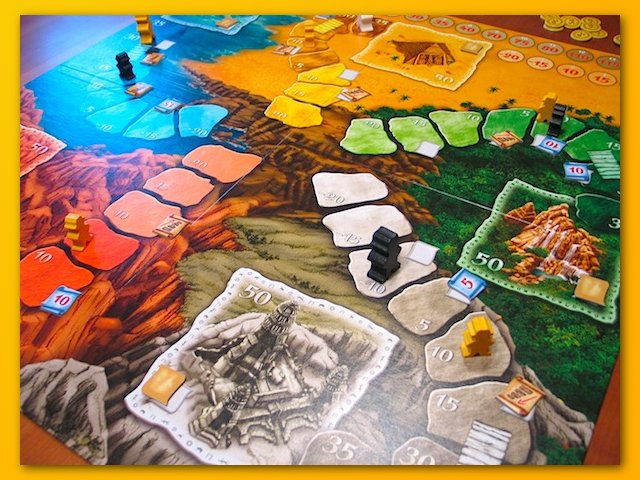
I like the game for what it is. It’s simple to teach and easy to grasp. It’s about the same weight as Ticket to Ride so it sits firmly in the family game genre and provides a nice way to pull in another 2 players into the mechanics presented in the 2-player card game. The ability to play cards equal to or greater than an existing adventure and the additional scoring opportunities provided by the tokens placed on the paths make the game more forgiving than the card game. We usually play with the tokens placed on the paths face-down. This provides a bit of a “what did you find?!” moment the first time somebody reaches the step. This is technically against the rules of placing them face-up. Having them face-down lightens the game even more taking away the knowledge of what paths are “worth going for” but we enjoy the a-ha! moment of finding things along the way more than the “fun” of the additional strategy.